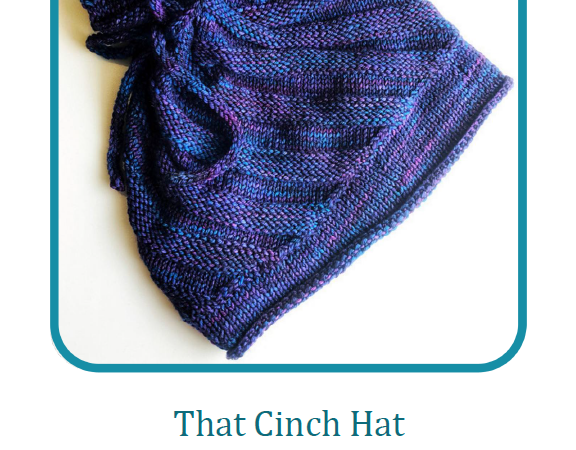
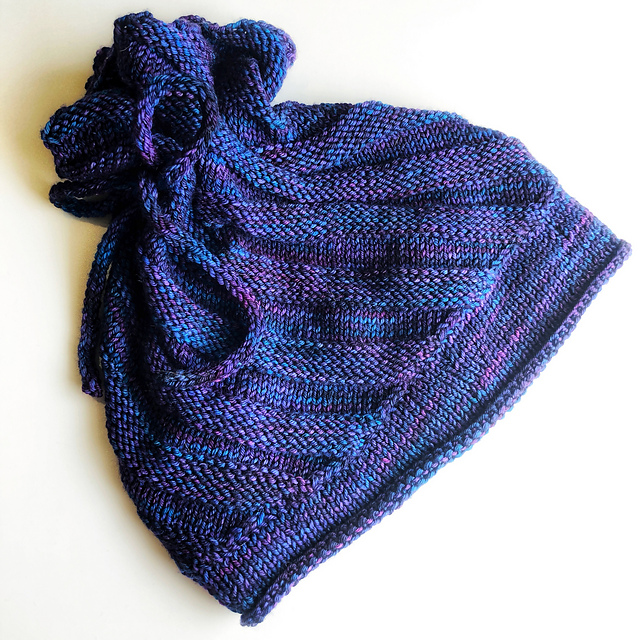
A former co-worker friend came to me with a hat. It had been her favourite for years and it had reached the stage where it was more hole than hat, thread-bare across the crown and genuinely past saving. She asked if I could make her another one.
I said yes, which I thought at the time was a small-ish favour.
I went looking for a pattern. I searched for hours, which anyone who has gone hunting for a specific construction will recognise as a particular kind of afternoon. Plenty of beanies, plenty of tuques, nothing that did what hers did. The hat had a diagonal texture that spiralled around the head, a drawstring through the crown, and a brim that sat deeper at the front than the back. Those three things together, in one hat, did not appear to exist as a pattern.
So, because I’m me, I took her hat apart to find out how it worked. [insert maniacal laugh here]
The parallelogram
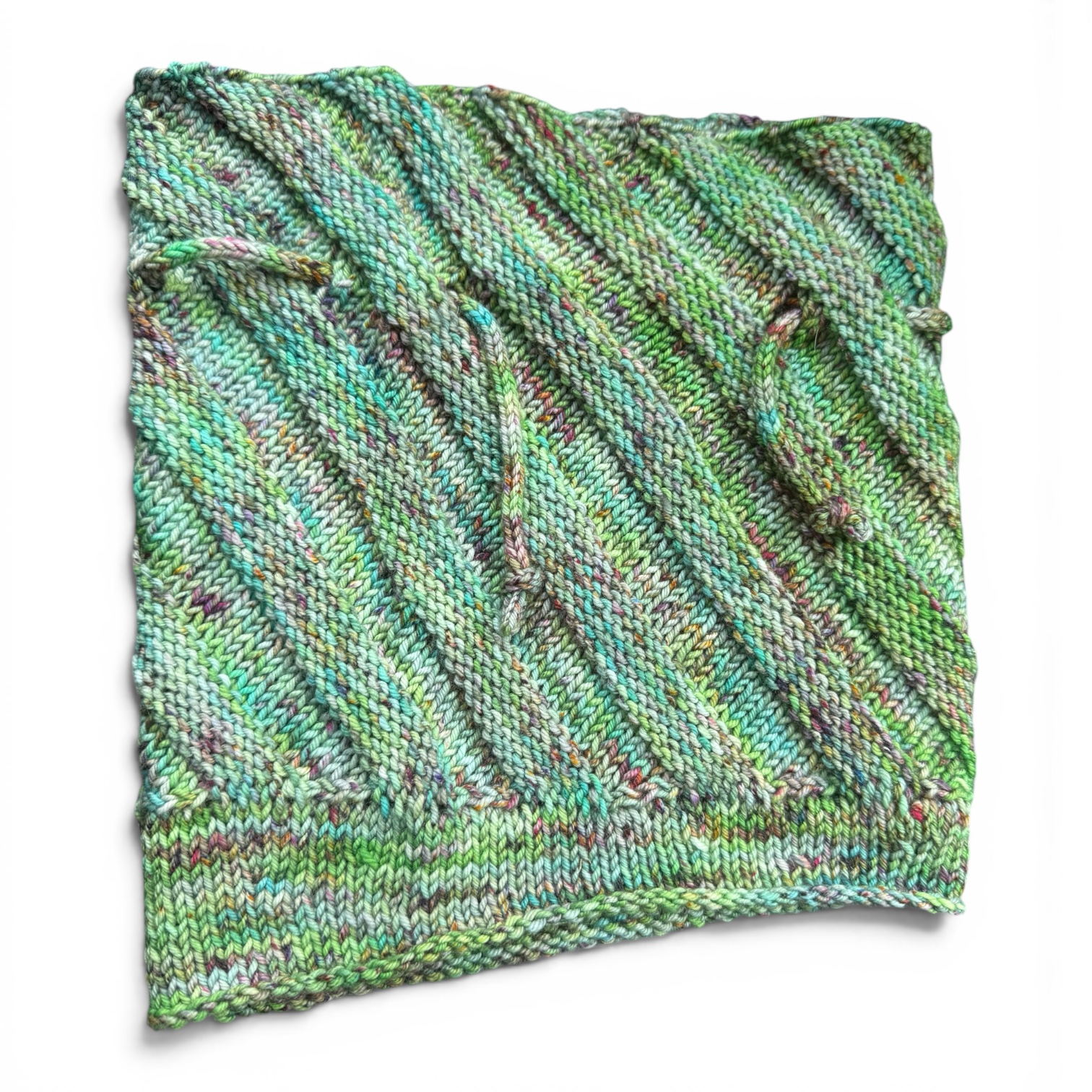
Here is the part that sounds wrong until you see it finished. The body of the hat is not a tube. It starts life as a flat parallelogram, worked on the bias by decreasing at the beginning of every shaping row and increasing at the end. The stitch count never changes. The fabric just leans.
When you seam that parallelogram into a tube, the welts that ran straight across the flat piece spiral around the head instead. The seam sits at an angle rather than running vertically, which is a side effect of the bias and also happens to make it much less noticeable than a straight seam would be.
I knit it three times before the proportions were right. The first one was too shallow, the second one was too wide. On version three, I found Goldilocks.
The brim and the short rows
Once the tube is seamed, the brim is picked up along the lower edge and knit downward in the round. Two decrease rounds bring it in slightly, and then a wedge of German short rows adds depth at the front.
That short row section is what makes the hat sit properly. Three inches of brim at the centre front, two at the centre back, so it covers your forehead without riding up at the nape. It’s a small amount of shaping that does a disproportionate amount of work, and it’s the reason the original hat got worn into oblivion rather than into a donation bag.
The cinch
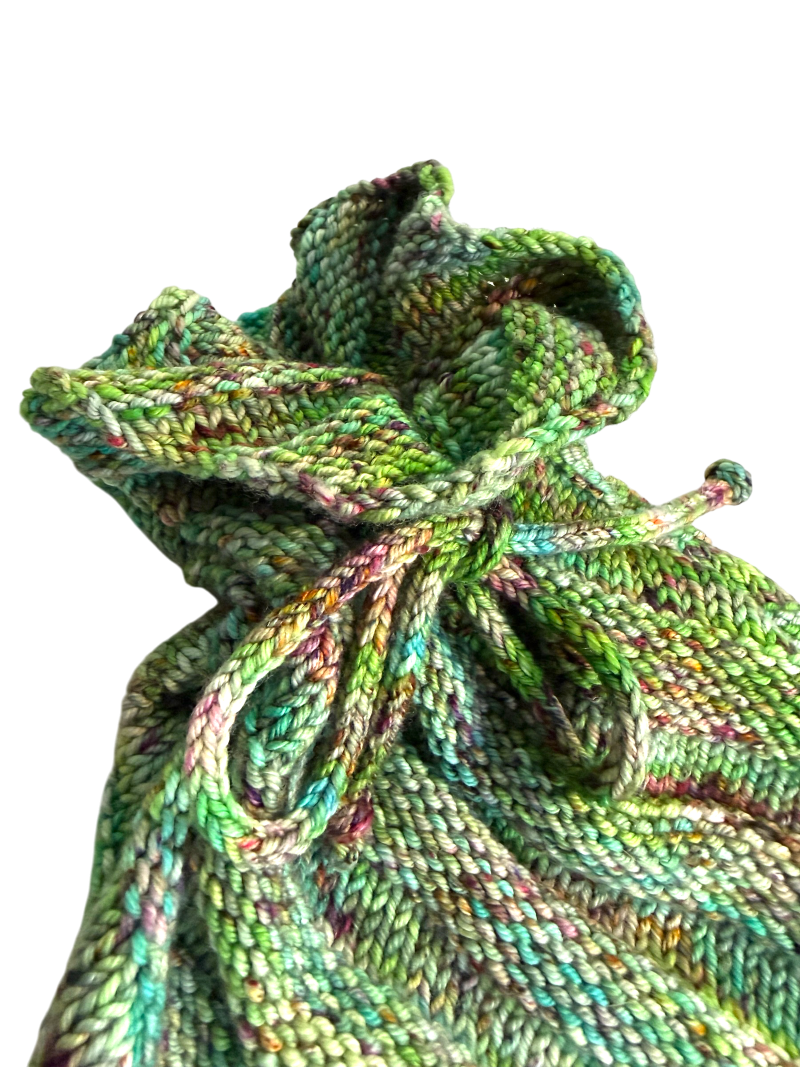
[PHOTO: crown, cinched, green sample]
Every twelfth row of the body has a single eyelet worked into it. Eleven eyelets in total, spiralling up with the welts. An I-cord threads through them and pulls the crown closed.
This means there are no crown decreases. No gathering a handful of stitches onto a tapestry needle and hoping. You knit a straight tube, thread a cord, and pull. The crown gathers itself into a soft rosette that you can cinch tight or leave loose depending on how you feel about the shape on a given day.
It’s also adjustable, which is not something most hats can claim.
The details
One size, 23 inches around, which fits most adults. If you want it snugger or looser, change needle size on the brim and leave everything else alone.
Worsted weight, one or two skeins, 210 yards or so. The purple sample is Malabrigo Rios in Whales Road and the green is Copperspoon Dye Co. Canadian Classic Worsted in Octopus’ Garden, dyed by my friend Claire on the island.
Skills you’ll want: knitting flat and in the round, basic increases and decreases, picking up stitches, German short rows, mattress stitch, and I-cord. If short rows are the part giving you pause, there are good tutorials out there, and I’m working on my own series of quick technique videos.
The pattern is seven pages, written instructions with a schematic and photographs, and it’s $7 USD on Ravelry.
One last thing
My friend has her hat. It’s in a different yarn than the original and she says it fits better than the one she wore out, which I am choosing to take at face value.
If you make one, I’d love to see it. Link your project on Ravelry or tag me on Instagram at @knicoleknits.